
Ground floor got flooded: when is it safe to switch power back on?
Keep the mains off until the floor and DB are dry, then have an electrician test each circuit, the sockets, the pump and the RCCB before anything goes on.
This guide is for first checks only. If there is shock, sparks, burning smell, active leakage near wiring, unstable structure or anything you are unsure about, stop and call a qualified professional.
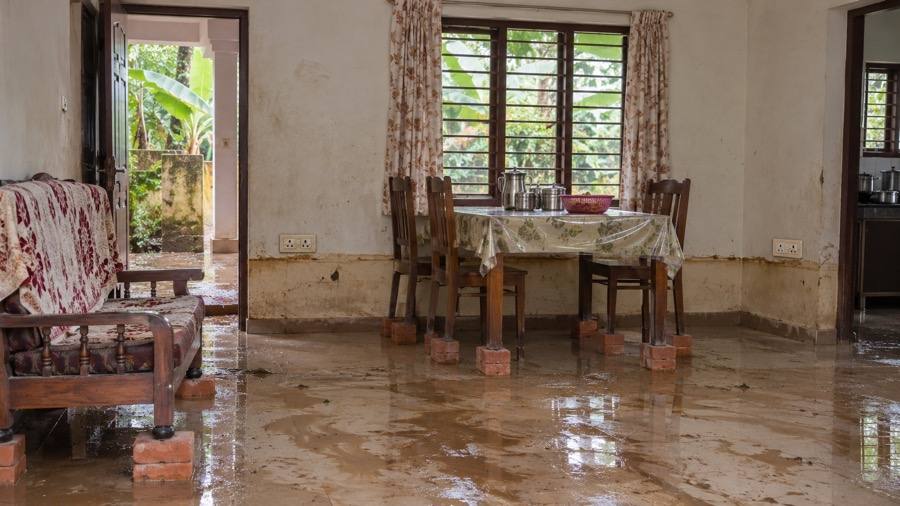
After a night of heavy rain, the call is often the same. Water came in up to the ankle or knee, it has gone down, and the family wants to know if they can switch the power on. Our answer does not change. Not yet, and not by yourself.
Why this usually happens
Flood water is not clean. It carries mud and salts, and when it gets into sockets, switch boxes, conduits and the DB, it leaves a film that can conduct even after the surface looks dry. Sockets fixed low on the wall, the pump switch, the inverter and any wiring near the floor take the worst of it.
Pumps in the sump area are often fully under water. Switching one on before it is checked can burn the motor winding or give a shock to whoever is standing nearby. An inverter that was flooded can also feed power into circuits you think are dead.
What we see in Trivandrum homes
In Trivandrum this mostly happens in low-lying parts of the city after long, heavy rain, near canals and on lower roads around Thampanoor, Chakkai, Pettah, Akkulam and Kannammoola. Many older houses here have sockets about a foot above the floor and the DB near the main door or under the stairs, so even a few inches of water reaches them. The sump and pump room usually sits at the lowest point of the plot.
What you can check safely
- Leave the main switch off. If the DB is wet, or you would be standing in water to reach it, do not go near it. Wait for the electrician.
- Keep the inverter off as well. Use torches and power banks for light.
- Mark the water line on the wall with a pencil. It tells the electrician which sockets and boxes went under.
- Open the doors and windows and let the house air out. Drying takes days, not hours.
- Once the floor is dry and the mains is off, unplug appliances that were on the floor or in low sockets. Do not use them until they are checked.
- Leave the pump alone. Note whether the motor and its switch were under water.
- If the meter, the service wire from the post or a line outside is affected, inform KSEB. That part is theirs to handle.
- From a dry, safe spot, take photos of the DB, sockets, pump and inverter area and send them to the electrician.
What not to do
- Do not touch the DB, switches or plugs while the floor, your hands or your feet are wet.
- Do not switch the mains on just to see if the lights work.
- Do not run the pump or inverter until both have been inspected.
- Do not use a hair dryer or heater on wet sockets to speed things up.
When to call Sameway
Call Sameway's 24/7 line and an electrician will check the DB, test each circuit, the pump and the RCCB, and bring power back circuit by circuit. Anything that is not safe stays off until it is repaired.
Common questions
How long should I wait before switching on power after flooding?
Until the DB, sockets and wiring are dry and an electrician has tested them. There is no fixed number of days. It depends on how high the water came and how fast the house dries.
Can I use the water pump after it was under water?
Not before it is checked. The motor and its switch or starter need to be dried and tested, or the motor can burn out or leak current into the pipes.
Do all sockets that went under water need replacing?
Not always. Many can be cleaned, dried and tested. Ones that show rust, burn marks or fail the test should be replaced.
Want us to check it?
Send a photo or short video on WhatsApp with your area in Trivandrum. We will reply with the safest next step and a clear quote when a visit is needed. Our charges are kept affordable, so it is worth asking before the problem grows.
WhatsApp Sameway