
Measure your plot before you build a compound wall
Before the compound wall foundation goes in, get the plot measured and the corners marked. A wall a foot off the line is costly to fix and starts disputes.
This guide is for first checks only. If there is shock, sparks, burning smell, active leakage near wiring, unstable structure or anything you are unsure about, stop and call a qualified professional.
A compound wall is one of the first things people build after buying a plot, sometimes before the house plan is even final. The mason asks where to start, and someone points at an old stone or a row of coconut trees. A lot of the boundary calls we get later begin exactly like that.
Why this usually happens
Once the foundation is in, moving it is slow and expensive. If the wall ends up a few inches inside your line, you lose that strip along the full length. If it ends up on the neighbour's side, you may have to break it. Old markers like trees, mud bunds or stones are not reliable on their own. They shift, get replaced, or were never exactly on the line.
The wall also has to work with the house. Setbacks for the building permit are usually measured from the boundary, so a wrong line can affect the house plan as well. Rules on setbacks and on walls along roads come from the corporation or panchayat, so check with them before you start.
What we see in Trivandrum homes
On the sloping laterite plots common around Kattakada, Vembayam and Pothencode, the compound wall often doubles as a retaining wall, and its line decides how the ground gets levelled. In city areas like Sasthamangalam or Vazhuthacaud, plots are tight and every inch of frontage counts. Low-lying plots that flood after heavy rain also need a plan for where the drain outlet goes through the wall.
What you can check safely
- Keep the deed, land tax receipt and any survey sketch or FMB ready before the surveyor comes.
- Get the whole plot measured and every corner marked with pegs, including the sides you are not building yet.
- Tell the neighbours when the measurement is happening and invite them to be there.
- Decide whether the wall will sit fully inside your line, or on the line by agreement. Get any agreement in writing.
- If the wall faces a road, check the road width and setback rules with the corporation or panchayat.
- Plan the gate width, car porch access, drain outlets and the meter and water connection points before the foundation.
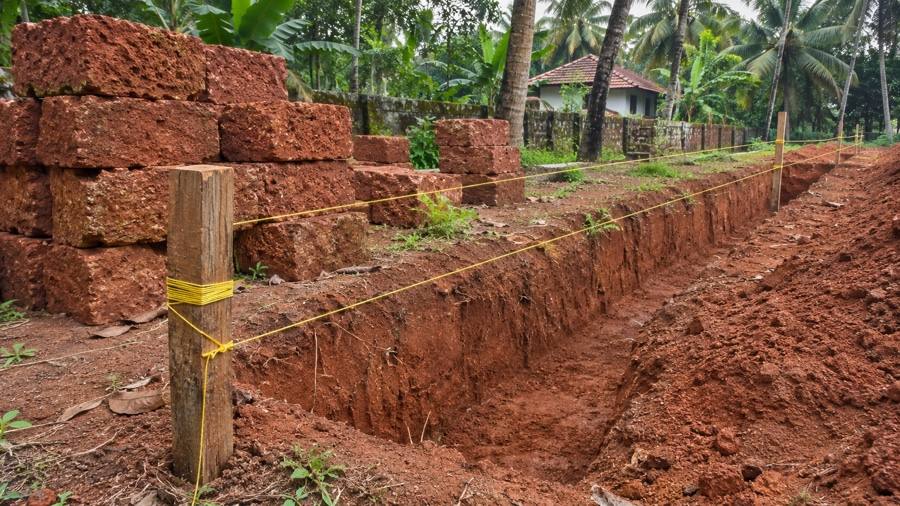
- Before digging, ask the mason to stretch a string between the marked pegs and check the line again.
- Keep the measured sketch safe. It helps if a question comes up years later.
What not to do
- Do not start the foundation based on an old stone or tree line alone.
- Do not pull out the survey pegs during digging. Mark offset points if they are in the way.
- Do not build on a disputed line hoping it will settle the matter.
When to call Sameway
Sameway measures the plot against your documents, marks the corners and gives you a measured sketch before the wall work starts. Once the wall is up, we can also do the gate light wiring, the drain pipe through the wall and the painting.
Common questions
Do I need a survey if an old compound wall is already there?
If you are rebuilding on the same line and the neighbours accept it, maybe not. If the old wall was never measured, or you are moving or extending it, measure first.
Should the compound wall be on the boundary line or inside it?
Many owners build fully inside their own line to avoid later arguments. Building on the line needs the neighbour's clear agreement, ideally in writing.
Do I need permission to build a compound wall?
It depends on the local body and the location, especially next to a road. Check with the corporation or panchayat before you start.
Want us to check it?
Send a photo or short video on WhatsApp with your area in Trivandrum. We will reply with the safest next step and a clear quote when a visit is needed. Our charges are kept affordable, so it is worth asking before the problem grows.
WhatsApp Sameway