
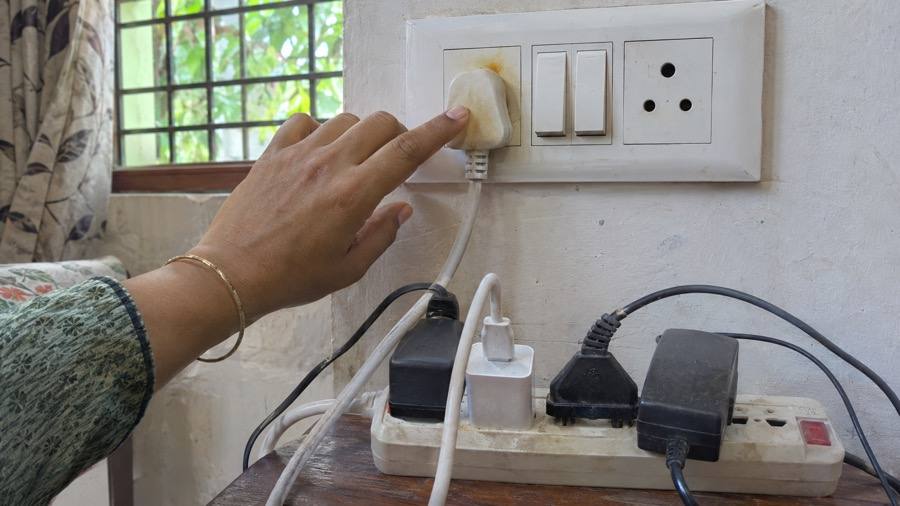
Switchboard, plug top or extension board feels warm
Warmth usually means a loose contact, a worn socket, thin wire or too much load on one point. Stop using that socket and get it checked before it burns.
This guide is for first checks only. If there is shock, sparks, burning smell, active leakage near wiring, unstable structure or anything you are unsure about, stop and call a qualified professional.
Customers usually notice it by accident. The iron box plug is hot to touch, or the switchboard next to the fridge feels warm through the plastic. Some have seen the plastic around one socket turn slightly yellow. Warm is the stage before burnt, so this is the right time to call.
Why this usually happens
Heat at a socket or plug almost always comes from resistance at a contact. Socket springs get loose after years of use, so the pins only touch on one side. The screws behind the socket loosen as the wire heats and cools every day. A plug top with a loose screw inside does the same thing. That small, poor contact heats up under load.
The other cause is plain overload. A 6 amp socket feeding a geyser, iron box or induction cooker. An extension board with a mixer, kettle and room heater on it at once. Cheap extension boards with thin wire warm up even at moderate load, and in our humid air the brass contacts tarnish faster, which adds more resistance.
What we see in Trivandrum homes
In older Trivandrum houses the kitchen often has one or two sockets for everything, so a single board carries the fridge, mixer, kettle and induction cooker. Homes near the sea at Vizhinjam, Poonthura and Valiyathura see greenish corrosion on socket brass much sooner. In April and May a board already sitting on a sun-facing wall or behind a fridge runs hotter to begin with.
What you can check safely
- Switch off and unplug whatever was running from the warm point. Dry hands, and pull by the plug body, not the cable.
- Next time a heavy appliance has run for a while, feel the plug top and then the socket plate. Note which one is warmer.
- Check if the plug sits loose or wobbles. A socket that does not grip the pins firmly needs replacing.
- Look for brown or yellow marks around the holes, or blackened, pitted plug pins.
- See what is plugged in. Heaters, iron boxes, geysers, induction cookers and ACs belong on a 16 amp power point with proper wire, not a small socket or extension board.
- For an extension board, read its rating and add up what runs on it. Many cheap boards are not meant for heating appliances at all.
- Move the heavy appliance to a proper power socket and leave the warm socket unused until it is checked.
What not to do
- Do not keep using a socket that is warm to touch after normal use.
- Do not plug one extension board into another.
- Do not open the switchboard to tighten screws yourself. Leave that to an electrician who will isolate the right circuit first.
- Do not use a two-pin adaptor to run a three-pin appliance from a small socket.
When to call Sameway
Sameway electricians replace worn sockets and plug tops, redo loose joints, check the wire size behind the board, and add a proper power point where one is missing. If the board has already browned or melted, we check the whole circuit, not just that socket.
Common questions
Is it normal for a plug to feel slightly warm?
Slight warmth after a heater or iron box has run for a long time can happen, but it should never be hot. If you cannot hold it comfortably, the contact or the load is wrong.
Can I run the fridge from an extension board?
It is better not to. A fridge should be on a fixed wall socket with a good earth. If you have no choice, use a good quality board with nothing else heavy on it.
Want us to check it?
Send a photo or short video on WhatsApp with your area in Trivandrum. We will reply with the safest next step and a clear quote when a visit is needed. Our charges are kept affordable, so it is worth asking before the problem grows.
WhatsApp Sameway