
Lights dim or flicker when the water motor or AC starts
A short dip when a motor or AC starts is common. If lights stay dim or flicker every time, check for low voltage, a loose neutral or overloaded wiring.
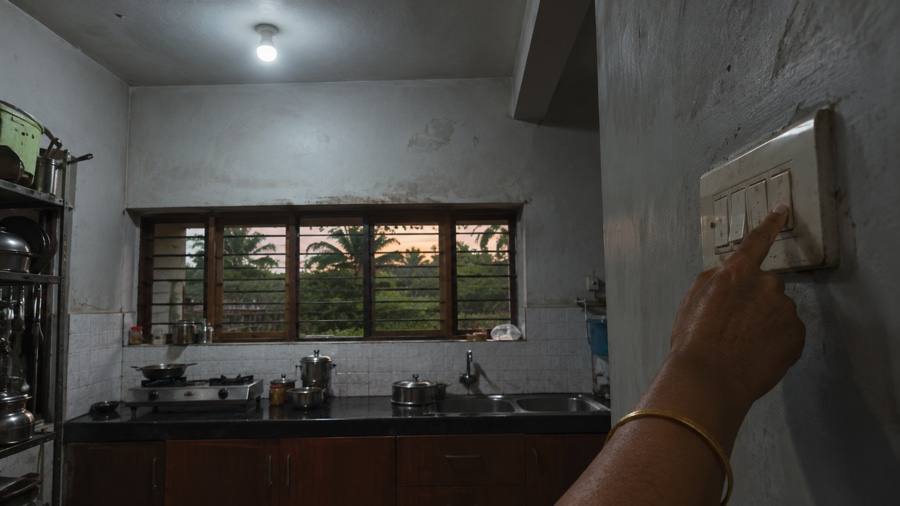
This guide is for first checks only. If there is shock, sparks, burning smell, active leakage near wiring, unstable structure or anything you are unsure about, stop and call a qualified professional.
People notice it at night. Someone switches on the motor to fill the overhead tank and every light in the house dips for a second. The fan slows. With the AC, the dip comes each time the compressor kicks in. A small dip is normal. Some of what we get called for is not.
Why this usually happens
Motors and AC compressors pull several times their running current for a moment at start. If the supply and wiring are healthy, the dip is quick and small. If there is resistance somewhere in the path, say a loose neutral at the main board, a corroded joint near the meter, a thin service wire, or everything sharing one long circuit, that starting surge pulls the voltage down much more.
Low supply voltage makes it worse. Houses at the far end of a long line, or on a transformer that is heavily loaded on summer evenings, already get low voltage, and a motor start pushes it lower still. A motor with a weak starting capacitor takes longer to pick up, so the dip lasts longer and the motor heats.
What we see in Trivandrum homes
This is common on the edges of the city, in places like Vattappara, Mannanthala and Malayinkeezhu, where the line from the transformer can be long. Evening voltage also drops in many areas from March to May, when every house is running ACs and motors. Older houses with a 1 HP motor fitted twenty years ago on a shared circuit notice it the most.
What you can check safely
- Watch the dip and time it roughly. A blink under a second is mostly normal. Lights staying dim for several seconds is not.
- See if it happens only in the evening or at all hours. Evening only suggests supply voltage. All the time points more to the wiring or the motor.
- If you have a stabiliser or inverter with a voltage display, note the reading before and while the motor starts.
- Listen to the motor. A hum before it picks up, or a slow start, can mean a weak capacitor.
- Notice what else happens at the same moment. Fan speed dropping a lot, the inverter switching to battery, the TV restarting.
- After the motor has run, check from outside whether the main board area feels warm or smells. Do not open it.
- Ask a neighbour if their lights dip too. If the whole road sees it, it is likely a supply issue to report to KSEB.
What not to do
- Do not ignore lights that get brighter than normal when something starts. That can mean a loose neutral, and it can damage appliances.
- Do not keep restarting a motor that hums and does not pick up. The winding can burn.
- Do not try to tighten connections at the meter or main board yourself.
When to call Sameway
Sameway can measure voltage at your board, tighten and test the neutral and main connections, check the motor capacitor, and see whether the motor or AC needs its own line. If the cause is the supply, we will tell you so you can take it up with KSEB.
Common questions
Is it normal for lights to dim when the AC starts?
A brief, small dip is normal. If the lights go noticeably dim for more than a second, or flicker every time, the wiring or supply should be checked.
Will a stabiliser stop the lights dimming?
No. A stabiliser protects the appliance connected to it, usually the AC or fridge. It does not fix a loose neutral or weak house wiring, and the lights will still dip.
Want us to check it?
Send a photo or short video on WhatsApp with your area in Trivandrum. We will reply with the safest next step and a clear quote when a visit is needed. Our charges are kept affordable, so it is worth asking before the problem grows.
WhatsApp Sameway